
Corporate Catering in Singapore: A Guide for HR and Office Teams
Summary:
A standard buffet order excludes Muslim colleagues, vegetarians, and guests with allergies unless dietary needs are planned for them deliberately.
Check for 2 credentials before booking: MUIS halal certification and an SFA Food Shop Licence.
Ask for the Majlis Ugama Islam Singapura (MUIS) certificate before confirming: “halal-friendly” is not the same as certified.
Match the catering format to the event type. The right setup shapes how guests move through the room, not just what they eat.
Confirm dietary headcount 72 hours out and get all accommodations in writing.
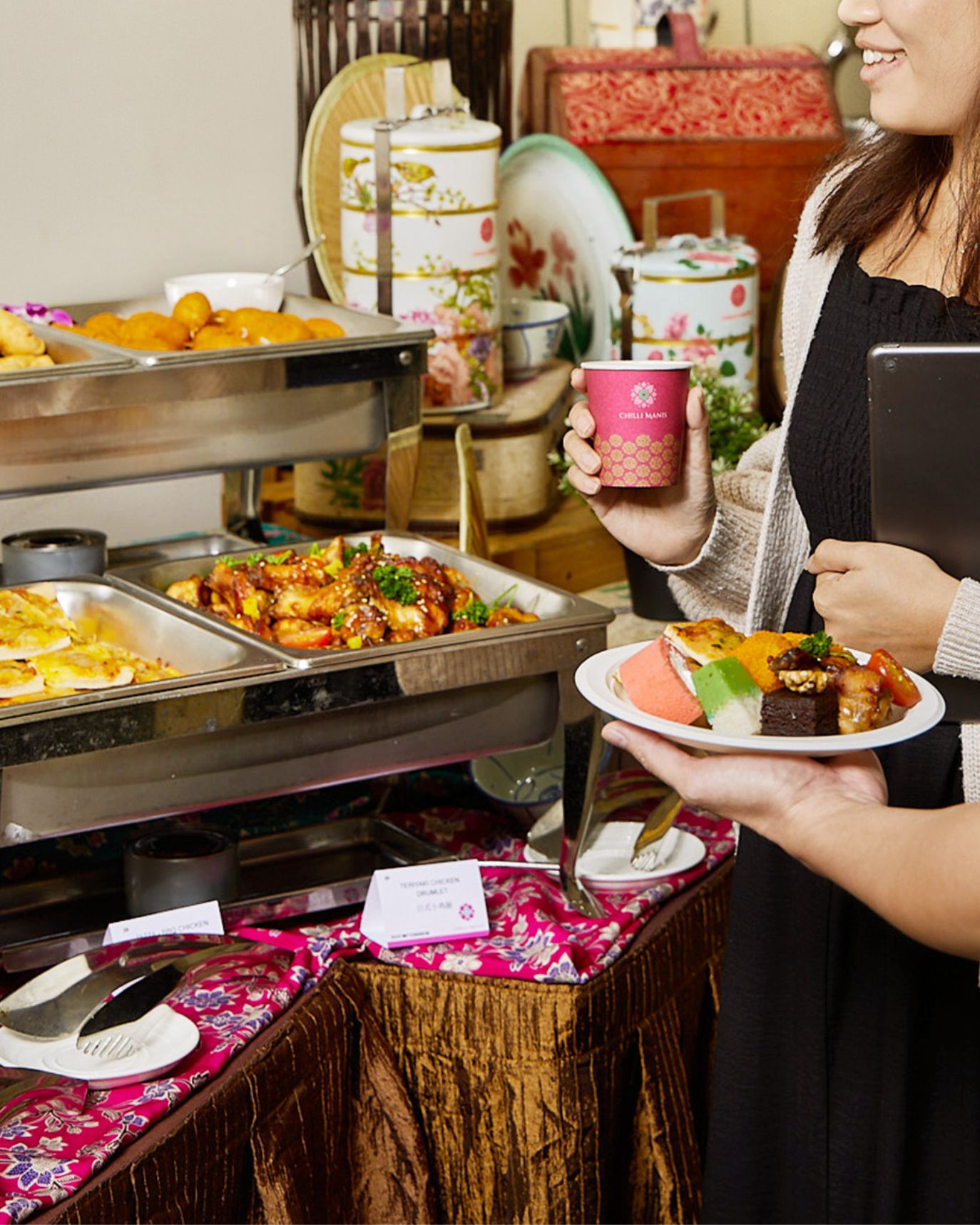
There is the part of corporate catering that everyone plans for: the menu, the headcount, the delivery window. And then there is the part that tends to surface on the day itself, when a colleague quietly skips the buffet line, or a client scans the spread and reaches for nothing.
For HR and office teams in Singapore, getting corporate catering right is not just a logistics task. It is one of the more visible ways a company communicates how it treats the people it has brought into the room.
Why Does Corporate Catering in Singapore Need More Than a Standard Buffet?
Placing a buffet order is straightforward. Planning one that works for everyone in the room is not. In Singapore’s multi-faith, multi-dietary workforce, a standard package built for the average guest will leave a visible gap. The companies that understand this treat catering as a people decision, not a procurement one.
The Real Challenge: One Order, Many Dietary Needs
Picture a company-wide lunch for 50 people. One buffet package, no dietary check. 4 Muslim colleagues eat plain rice. 2 vegetarians share a side salad. The event is still logged as a success.
Singapore’s workforce spans a wide range of religious observances and dietary practices. An office of 50 might include:
- Muslim colleagues who require MUIS halal-certified food
- Vegetarians and vegans who cannot share a non-vegetarian buffet line
- Colleagues who avoid pork for religious or personal reasons
- Guests with food allergies that require advance notice.
The people left out notice it. So does everyone sitting next to them.
What Does Your Catering Say Before Anyone Speaks?
Shared meals have long been linked to trust and a sense of belonging. In a workplace context, consider what each occasion communicates:
- An onboarding lunch where every new hire can eat freely sets a tone an induction deck cannot
- A client dinner where dietary needs are anticipated signals attentiveness a generic thank-you email cannot
- A team celebration that accommodates everyone reinforces belonging in a way a speech cannot
The standard is one where nobody has to ask whether there is something they can eat.
See how Chilli Manis handles corporate catering in Singapore: inclusive menus, on-site setup, every guest covered. Send the team a message to talk through what your event needs.
What to Look for in a Corporate Caterer in Singapore
Not every caterer operates to the same standard, and the differences matter most when the event matters most. The right caterer is not simply one that delivers food on time. It is one whose defaults align with the requirements of a diverse guest list.
Halal Certification and Food Safety: The Non-Negotiables
2 credentials are non-negotiable for any corporate caterer in Singapore.
| Credential | What It Covers | Why It Matters |
|---|---|---|
| MUIS Halal Certification | Kitchen, ingredients, and handling are certified by the MUIS | Muslim guests can eat without verifying suitability |
| SFA Food Shop Licence | Confirms the business is licensed by the Singapore Food Agency to sell food | Baseline food safety compliance for all guests |
A caterer unable or unwilling to share either should not be shortlisted.
Can Your Caterer Guarantee Delivery When It Counts?
A seminar break can be 20 minutes long. A client meeting has an agenda built around when the food arrives. Use these as your baseline checks:
- Ask for references from corporate clients specifically, not just general reviews.
- Ask how late deliveries are handled and what the protocol is.
- Confirm there is a dedicated event contact available on the day.
Halal-Certified vs General Catering Vendors: What’s the Difference
The distinction between a halal-certified caterer and one who “offers halal options” matters.
| Factor | Halal-Certified Caterer | General Caterer With Halal Options |
|---|---|---|
| Certification scope | Kitchen, ingredients, and handling are certified end-to-end by MUIS | Individual dishes may be halal; the kitchen and processes may not be |
| Cross-contamination risk | Managed as a standard requirement | Dependent on individual kitchen protocols |
| Guest confidence | Muslim guests can eat without verification | Muslim guests may need to ask, check, or decline |
For any corporate event in Singapore where Muslim colleagues or guests are present, choosing a caterer without end-to-end MUIS certification carries a risk that a certified caterer would not.
Seminar Catering in Singapore: What's Different About Event-Day Logistics
Seminar catering operates under constraints that a standard office lunch does not. The programme has fixed timings, and the catering has to work around both the schedule and the room without becoming the thing people remember for the wrong reasons.
Chilli Manis’s seminar buffet menu is built around exactly this kind of tight-window, fixed-schedule event, with formats designed to fit around break slots rather than compete with them.
Timing Coordination with AV and Room Setup
Before confirming any seminar catering order, clarify:
- Confirm what time the room becomes accessible for setup
- Check whether there is a holding area if the room is not ready on arrival
- Verify the timing of all break slots, not just the first
- Confirm who the on-site contact is and how they receive updates
- Clarify whether the caterer clears between breaks or leaves food throughout.
A caterer experienced in seminar logistics will have a default answer to all of these. If they need time to check, that is a signal worth noting before the booking is confirmed.
Seated or Standing: Which Catering Format Fits Your Event?
The format shapes how guests move through the room and how the break feels.
| Event Format | Recommended Setup | Why It Works |
|---|---|---|
| Seated seminar, single break | Bento or set meals | Fast service, no queue management required |
| Standing networking break | Mini buffet | Guests move freely, and conversation flows naturally |
| Multi-break conference | Full buffet refreshed between sessions | Avoids food fatigue across a full day |
| Hybrid seated and standing | Full buffet with live stations | Gives the event a focal point with variety for a diverse guest list |
The format conversation is one a good catering partner should raise with you during the planning stage, not one you should have to initiate.
Planning a Menu for Diverse Dietary Requirements
Getting the guest list right is only half the brief. The menu has to follow. In a workplace with varied dietary needs, the most common mistake is planning for the majority and treating everyone else as an afterthought, and the gap shows up on the day, not in the planning notes.
One Menu, Every Dietary Need: How to Make It Work
One deliberate menu can cover most dietary requirements without separate meal plans.
| Practice | Why It Matters |
|---|---|
| Anchor the menu around a halal-certified base | Creates a shared foundation for the most structurally defined dietary requirement |
| Include at least 2 substantive vegetarian dishes | A hot option, protein, and carbohydrate make a complete meal |
| Label every dish clearly, including allergens | Removes the need for guests to ask |
| Avoid halal and non-halal dishes that look identical | Visual similarity creates uncertainty at the serving point |
| Confirm dietary headcount 72 hours before the event | Last-minute requests are harder to accommodate |
None of these practices require a separate menu. They require a caterer who treats inclusion as the default, not the exception.
Common Menu Mistakes That Quietly Cause Problems
Most menu errors are avoidable with a quick check before ordering.
| Mistake | How to Avoid It |
|---|---|
| No hot vegetarian option | Specify at least one hot vegetarian main when ordering |
| Unlabelled dishes | Require dish labels as a standard deliverable |
| Underordering for dietary groups | Count dietary requirements separately in your headcount |
| Ordering for the average guest | Plan from the most restrictive requirement outward |
A menu that fails one guest tends to be visible to the whole table. The fix, in most cases, is simply asking the right questions before the order is placed.
Getting the menu right starts before the order is placed. If you want a caterer that handles dietary inclusion as a default, get in touch with Chilli Manis to talk through your next event.
Questions to Ask Before You Book a Corporate Caterer
How directly a caterer answers your questions tells you more than their menu brochure. The booking conversation is where a vendor’s operational readiness, or the gaps in it, tend to surface.
3 Questions to Ask Before Anything Else
Ask these before discussing menus, formats, or pricing. The answers tell you whether the conversation is worth continuing.
| Question | What a Strong Answer Looks Like |
|---|---|
| Are you MUIS halal-certified, and can you share your certificate? | A certificate number and expiry date, shared without hesitation |
| Can you accommodate this dietary breakdown: X halal, Y vegetarian, Z with allergies? | A direct yes with confirmation of how each requirement will be met |
| Who is our on-day contact, and what is the escalation process? | A named contact, a mobile number, and a clear protocol |
A caterer who deflects or needs time to check any of these is signalling a gap in readiness.
What Red Flags Should You Watch for in a Catering Quote?
A quote is not just a price list. How it is structured, and what it leaves out, tells you something about how the vendor operates. Watch for:
- No Itemised Breakdown: A lump sum makes it difficult to assess value or adjust scope.
- No Mention of Setup and Clearance: Ask who handles it and at what cost.
- Vague Halal Language: “Halal-friendly” is not MUIS certification; ask for the certificate.
- No Minimum Notice Period: Suggests limited capacity to deliver consistently.
- No Written Dietary Confirmation: Verbal assurances are not sufficient.
If a quote raises more questions than it answers, that is useful information before you sign anything.
Plan Your Next Corporate Catering Event with Chilli Manis
Planning a corporate event and not sure if your current caterer covers everyone at the table? Chilli Manis is a MUIS halal-certified Peranakan catering specialist serving corporate clients across Singapore. Led by Chef Mdm Serene Hoh, the team handles everything from menu planning to on-site setup, with inclusion built in from the start.
Explore the corporate catering menus or request a quote from the team. The best corporate catering in Singapore starts with making sure everyone at the table has a full plate.